---
products: oss-community
---
import Tabs from "@theme/Tabs";
import TabItem from "@theme/TabItem";
import { FontAwesomeIcon } from "@fortawesome/react-fontawesome";
import { faWindows } from "@fortawesome/free-brands-svg-icons";
# abctl
abctl is Airbyte's open source command line tool to create and manage local instances of Airbyte running in Docker.
## Overview of abctl
Airbyte runs on Kubernetes. People run Airbyte in a diverse set of environments like a local computer, a bare metal server, or a virtual machine. However, you might not be running Kubernetes and might not even know much about it. abctl makes it easy to run Airbyte anywhere Docker is running.
### When to use abctl
You use abctl to run Airbyte on a machine that isn't running a Kubernetes cluster, but is running Docker. Normally, you don't use abctl to manage enterprise deployments, because they use dedicated Kubernetes infrastructure. However, it's possible to use abctl this way if you want to.
### What abctl does
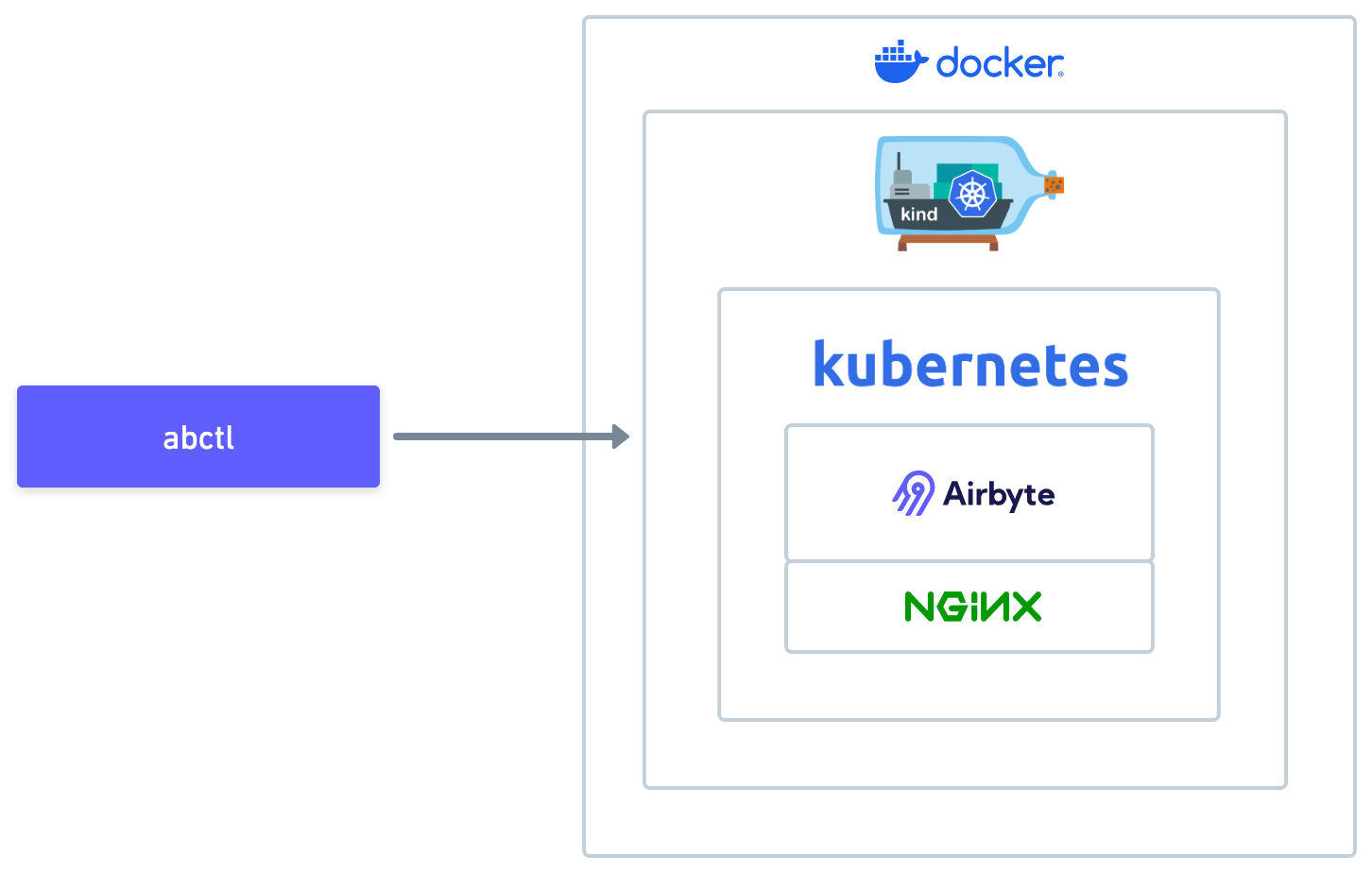
abctl uses [kind](https://kind.sigs.k8s.io/) to create a [Kubernetes](https://kubernetes.io/) cluster inside a [Docker](https://www.docker.com/) container. Then, it uses [Helm](https://helm.sh/) to install the latest Airbyte and [NGINX Ingress Controller](https://docs.nginx.com/nginx-ingress-controller/) Helm charts. It also helps you manage and understand that infrastructure.
## Before you start
Before you use abctl, install Docker Desktop on your machine:
- [Mac](https://docs.docker.com/desktop/install/mac-install/).
- [Windows](https://docs.docker.com/desktop/install/windows-install/).
- [Linux](https://docs.docker.com/desktop/install/linux-install/). If you're installing on a Linux headless virtual machine, you may have an easier time using [Docker Engine](https://docs.docker.com/engine/install/) instead of Docker Desktop. See [the EC2 guide](../abctl-ec2) for an example.
## Install abctl
To install abctl, follow the instructions for your operating system.
Use curl to install abctl.
1. Open a terminal and run the following command.
```shell
curl -LsfS https://get.airbyte.com | bash -
```
2. If your terminal asks you to enter your password, do so.
When installation completes, you see `abctl install succeeded`.
Use [go install](https://go.dev/ref/mod#go-install) to install abctl.
Open a terminal and run the following command.
```bash
go install github.com/airbytehq/abctl@latest
```
Use [Homebrew](https://brew.sh/) to install abctl.
1. Install Homebrew, if you haven't already.
2. Run the following commands after Homebrew is installed.
```bash
brew tap airbytehq/tap
brew install abctl
```
3. Keep abctl up to date with Homebrew, too.
```bash
brew upgrade abctl
```
1. Verify your processor architecture.
```bash
uname -m
```
If the output is `x86_64`, you'll download the **linux-amd64** release. If the output is `aarch64` or similar, you'll download the **linux-arm64** release.
2. Download the file that is compatible with your machine's processor architecture
Latest Linux Release
3. Extract the archive. This creates a directory named `abctl`, which contains the executable and other needed files.
```bash
tar -xvzf {name-of-file-downloaded.linux-*.tar.gz}
```
4. Make the extracted executable accessible. This allows you to run `abctl` as a command.
```bash
chmod +x abctl/abctl
```
5. Add `abctl` to your PATH. This allows you to run `abctl` from any directory in your terminal.
```bash
sudo mv abctl /usr/local/bin
```
6. Verify the installation. If this command prints the installed version of abctl, you can now use it to manage a local Airbyte instance.
```bash
abctl version
```
1. Verify your processor architecture.
1. Press Windows + I.
2. Click **System** > **About**.
3. Next to **Processor**, if it says `AMD`, you'll download the **windows-amd64** release. If the output is `ARM` or similar, you'll download the **windows-arm64** release.
2. Download the latest release of `abctl`.
Latest Windows Release
3. Extract the zip file to a destination of your choice. This creates a folder containing the abctl executable and other required files. Copy the filepath because you'll need this in a moment.
4. Add the executable to your `Path` environment variable.
1. Click **Start** and type `environment`.
2. Click **Edit the system environment variables**. The System Properties opens.
3. Click **Environment Variables**.
4. Find the Path variable and click **Edit**.
5. Click **New**, then paste the filepath you saved in step 3.
6. Click **OK**, then click **OK**, then close the System Properties.
5. Open a new Command Prompt or PowerShell window. Changes to your Path variable only take effect in a new Window.
6. Verify abctl is installed correctly. If this command prints the installed version of abctl, you can now use it to manage a local Airbyte instance.
```bash
abctl version
```
## Install and manage local Airbyte instances
This section shows you how to use abctl. It's not a step-by-step guide to deploy Airbyte. See Airbyte's [Quickstart](../../using-airbyte/getting-started/oss-quickstart.md) or [deployment guides](../deploying-airbyte.md) for a complete explanation.
### Install or update Airbyte
To install or update Airbyte, run:
```bash
abctl local install
```
Optional flags are available and you can combine them in powerful ways. For example, you can create a Kubernetes secret and customize your Airbyte installation using a yaml file to make use of that secret.
```bash
abctl local install --secret YOUR_SECRET --values values.yaml
```
For a list of all flags, see the [full reference](#reference).
:::note
Depending on your internet speed, `abctl local install` may take up to 30 minutes.
:::
### Get information about your Airbyte instance
If an Airbyte installation exists, you can get critical information about that installation.
```bash
abctl local status
```
For example:
```bash
$ abctl local status
Existing cluster 'airbyte-abctl' found
Found helm chart 'airbyte-abctl'
Status: deployed
Chart Version: 0.422.2
App Version: 0.63.15
Found helm chart 'ingress-nginx'
Status: deployed
Chart Version: 4.11.1
App Version: 1.11.1
Airbyte should be accessible via http://localhost:8000
```
### View and change credentials
If an Airbyte installation exists, you can view and update the credentials needed to access that installation.
To view credentials, run:
```bash
abctl local credentials
```
To update credentials, run:
```bash
abctl local credentials --email YOUR_EMAIL --password YOUR_PASSWORD
```
abctl returns something like this:
```bash
{
"email": "[YOUR EMAIL]",
"password": "[RANDOM PASSWORD]",
"client-id": "[RANDOM CLIENT-ID]",
"client-secret": "[RANDOM CLIENT-SECRET]"
}
```
### Manage your local Kubernetes instance
To display Kubernetes deployment information, run:
```bash
abctl local deployments
```
If you need to restart Kubernetes, run:
```bash
abctl local deployments --restart
```
### Uninstall Airbyte
To stop running all containers, but keep your data, run:
```shell
abctl local uninstall
```
To stop running containers and delete all data:
1. Uninstall Airbyte with the `--persisted` flag.
```shell
abctl local uninstall --persisted
```
2. Clear any remaining information abctl created.
```shell
rm -rf ~/.airbyte/abctl
```
## Manage Docker images
To get a manifest of the images used by Airbyte and abctl, run:
```bash
abctl images manifest
```
## Get abctl version information
To display version information about the abctl tool, run `abctl version`.
```bash
$ abctl version
version: v0.19.0
```
## Help and debugging
All abctl commands and sub-commands support two flags:
- `--help`: Displays help information, describing the available options for this command.
- `--verbose`: Enables verbose/debug output. This is useful when debugging unexpected behavior.
## Disable telemetry
You can turn off telemetry tracking on the abctl tool by setting the environment variable `DO_NOT_TRACK` to any value.
## Full abctl reference {#reference}
abctl has three commands: `local`, `images`, and `version`. Most commands have sub-commands and support various flags.
`local`
Local sub-commands are focused on managing the local Airbyte installation.
`credentials`
Display the credentials required to login to the local Airbyte installation.
When `abctl local install` is first executed, a random `password`, `client-id`, and `client-secret` are generated. Returns the `email`, `password`, `client-id`, and `client-secret` credentials. The `email` and `password` are required to login to Airbyte. The `client-id` and `client-secret` are necessary to create an [Access Token for interacting with the Airbyte API](https://reference.airbyte.com/reference/createaccesstoken).
`credentials` has the following flags.
| Name | Default | Description | Example |
| ---------- | ------- | ----------------------------------------- | ---------------- |
| --email | "" | Changes the authentication email address. | you@example.com |
| --password | "" | Changes the authentication password. | MyStrongPassword |
`deployments`
Display kubernetes deployment information and allows for restarting a kubernetes deployment.
`deployments` has the following flags.
| Name | Default | Description | Example |
| --------- | ------- | --------------------------------- | ------- |
| --restart | "" | Restarts the provided deployment. | webapp |
`install`
Installs a local Airbyte instance or updates an existing installation which was initially installed by `abctl`.
Depending on your internet speed, `abctl local install` may take up to 30 minutes.
`install` has the following flags.
| Name | Default | Description | Example |
| ------------------- | ------- | ------------------------------------------------------------------------------------------------------------------------------------------------------------------------------------------------------------------------------------------------------ | -------------------------- |
| --chart | "" | Path to chart. | ./my-chart |
| --chart-version | latest | Which Airbyte helm-chart version to install. | 0.422.2 |
| --docker-email | "" | Docker email address to authenticate against `--docker-server`. Can also be specified by the environment-variable `ABCTL_LOCAL_INSTALL_DOCKER_EMAIL`. | user@example.com |
| --docker-password | "" | Docker password to authenticate against `--docker-server`. Can also be specified by the environment-variable `ABCTL_LOCAL_INSTALL_DOCKER_PASSWORD`. | mypassword |
| --docker-server | "" | Docker server to authenticate against. Can also be specified by the environment-variable `ABCTL_LOCAL_INSTALL_DOCKER_SERVER`. | docker.io |
| --docker-username | "" | Docker username to authenticate against `--docker-server`. Can also be specified by the environment-variable `ABCTL_LOCAL_INSTALL_DOCKER_USERNAME`. | myusername |
| --insecure-cookies | - | Disables secure cookie requirements. Only set if using `--host` with an insecure (non `https`) connection. | - |
| --low-resource-mode | false | Run Airbyte in low resource mode. | true |
| --host | "" | FQDN where the Airbyte installation will be accessed. Default is to allow for all incoming traffic on port `--port`. Set this if the Airbyte installation needs a more restricted host configuration. | airbyte.example.com |
| --no-browser | - | Disables launching the browser when installation completes. Useful to set in situations where no browser is available. | - |
| --port | 8000 | Port where the Airbyte installation will be accessed. Set this if port 8000 is already in use or if a different port is preferred. | 9000 |
| --secret | "" | **Can be set multiple times**. Creates a kubernetes secret based on the contents of the file provided. Useful when used in conjunction with `--values` for customizing installation. | ./my-secret.yaml |
| --values | "" | Helm values file to further customize the Airbyte installation. | ./values.yaml |
| --volume | "" | **Can be set multiple times**. Mounts additional volumes in the kubernetes cluster. Must be in the format of `:`. | /host/path:/container/path |
`status`
If an Airbyte installation exists, returns information regarding that installation.
For example:
```
$ abctl local status
Existing cluster 'airbyte-abctl' found
Found helm chart 'airbyte-abctl'
Status: deployed
Chart Version: 0.422.2
App Version: 0.63.15
Found helm chart 'ingress-nginx'
Status: deployed
Chart Version: 4.11.1
App Version: 1.11.1
Airbyte should be accessible via http://localhost:8000
```
`uninstall`
Uninstalls a local Airbyte instance.
The data associated with the installed Airbyte instance will not be removed. This is done to allow Airbyte to be reinstalled at a later date with all the data preserved.
`uninstall` has the following flags.
| Name | Default | Description | Example |
| ----------- | ------- | ------------------------------------------------------------------------------ | ------- |
| --persisted | - | Will remove all data for the Airbyte installation. This cannot be undone. | - |
`images`
Manage images used by Airbyte and abctl.
`manifest`
Display a manifest of images used by Airbyte and abctl.
`manifest` has the following flags.
| Name | Default | Description | Example |
| --------------- | ------- | ---------------------------------------------------------------- | ------------- |
| --chart | "" | Path to chart. | ./my-chart |
| --chart-version | latest | Which Airbyte Helm chart version to install. | 0.422.2 |
| --values | "" | Helm values file to further customize the Airbyte installation. | ./values.yaml |
`version`
Displays version information about the `abctl` tool.
For example:
```
$ abctl version
version: v0.19.0
```