
2.2 KiB
id, title, challengeType, forumTopicId, dashedName
| id | title | challengeType | forumTopicId | dashedName |
|---|---|---|---|---|
| 5900f4031000cf542c50ff15 | Problem 150: Durchsuchen eines dreieckigen Feldes nach einem Unterdreieck mit minimaler Summe | 1 | 301781 | problem-150-searching-a-triangular-array-for-a-sub-triangle-having-minimum-sum |
--description--
In einer dreieckigen Anordnung positiver und negativer Integer soll ein Unterdreieck gefunden werden, bei dem die Summe der darin enthaltenen Zahlen die kleinstmögliche ist.
In the example below, it can be easily verified that the marked triangle satisfies this condition having a sum of −42.
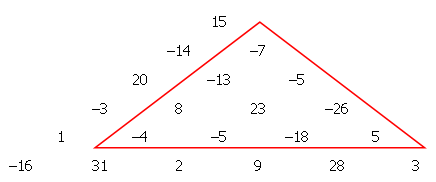
We wish to make such a triangular array with one thousand rows, so we generate 500500 pseudo-random numbers s_k in the range ±2^{19}, using a type of random number generator (known as a Linear Congruential Generator) as follows:
$$\begin{align} t := & \ 0\\ \text{for}\ & k = 1\ \text{up to}\ k = 500500:\\ & t := (615949 × t + 797807)\ \text{modulo}\ 2^{20}\\ & s_k := t − 219\\ \end{align}$$
Thus: s_1 = 273519, s_2 = −153582, s_3 = 450905 etc.
Our triangular array is then formed using the pseudo-random numbers thus:
$$ s_1 \\ s_2\;s_3 \\ s_4\; s_5\; s_6 \\ s_7\; s_8\; s_9\; s_{10} \\ \ldots $$
Sub-triangles can start at any element of the array and extend down as far as we like (taking-in the two elements directly below it from the next row, the three elements directly below from the row after that, and so on).
The "sum of a sub-triangle" is defined as the sum of all the elements it contains.
Find the smallest possible sub-triangle sum.
--hints--
smallestSubTriangleSum() should return -271248680.
assert.strictEqual(smallestSubTriangleSum(), -271248680);
--seed--
--seed-contents--
function smallestSubTriangleSum() {

  return true;
}

smallestSubTriangleSum();
--solutions--
// solution required